The Australian share market rose 2.9% during the month. Conversely the MSCI World Index in Australian dollars was down -0.4%. The difference somewhat due to movements in the Australian dollar.
The combination of stretched valuations, optimistic investor sentiment, the still high risk of recession in the US and Australia, the expansion of the war in the Middle East to potentially impact oil supplies and the US election means that the risk of another correction is high. On a 6-12 month view though shares are likely to head higher on the back of the success in getting global inflation down, central bank rate cuts (with the RBA getting closer to joining in) and China ramping up policy stimulus. October can often see high levels of share market volatility, but beyond that we are now coming into a positive time of the year for shares from a seasonal perspective after they performed surprisingly well through the normally weak months of August and September.
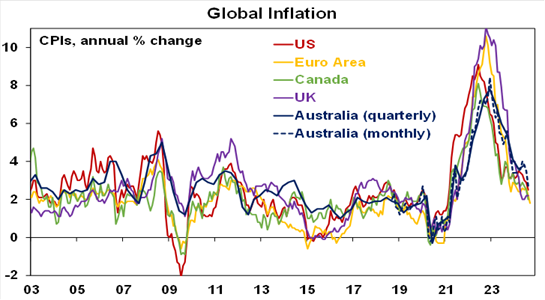
Meanwhile the good news on global inflation continued to flow over the last week with another fall in Eurozone inflation. The ECB is on track for another rate cut this month (possibly 0.5%) and Bank of England Governor Bailey said it could become “a bit more aggressive” in cutting rates. Meanwhile, comments by Fed Chair Powell reaffirmed its base of 0.25% cuts, with solid payrolls data for September leaning against another 0.5% cut but soft forward looking US jobs data consistent with 0.25% cuts. Fortunately, the US port strike impacting US East and Gulf coast ports has already ended causing minimal impact on supply chains.
Australian economic data releases were a mixed bag suggesting the economy is continuing to muddle along with weak growth. Retail sales rose a stronger than expected 0.7% in August. This may reflect the tax cuts. Despite the rise in retail sales, the ABS’s Monthly Household Spending Indicator was flat in August with annual growth slowing to 1.7% YoY, pointing to ongoing weakness in real consumer spending.
Home prices continued to rise in September according to CoreLogic, but the pace is modest and there is a big divergence between strength in Brisbane, Perth and Adelaide and weakness elsewhere. The fundamental housing shortfall remains but is being offset by poor affordability and high interest rates.
Easing inflation pressures, central banks cutting rates, China ramping up policy stimulus and prospects for stronger growth in 2025-26 should make for reasonable investment returns over the next 6-12 months. However, with a high risk of recession, poor valuations and significant geopolitical risks particularly around the Middle East and US election, the next 12 months are likely to be more constrained and rougher compared to 2023-24.
Bonds are likely to provide returns around running yield or a bit more, as inflation slows, and central banks cut rates.
Unlisted commercial property returns are likely to remain negative due to the lagged impact of high bond yields and working from home reducing office space demand.
Cash and bank deposits are expected to provide returns of over 4%, reflecting the back up in interest rates.
Important note: While every care has been taken in the preparation of this document, Farrow Hughes Mulcahy make no representations or warranties as to the accuracy or completeness of any statement in it including, without limitation, any forecasts. Past performance is not a reliable indicator of future performance. This document has been prepared for the purpose of providing general information, without taking account of any particular investor’s objectives, financial situation or needs. An investor should, before making any investment decisions, consider the appropriateness of the information in this document, and seek professional advice, having regard to the investor’s objectives, financial situation and needs. This document is solely for the use of the party to whom it is provided.
Source: AMP Capital, AZ Sestante, Zenith.