














The Financial year ended with strong performance recorded by both Australian share markets which rose 12% for the year (ASX 200) and world share markets which increased by 19% (MSCI World $Au).
Shares are continuing to climb a wall of worry. Stretched valuations particularly for US shares, elevated investor sentiment, ongoing recession risks and high geopolitical uncertainty particularly around the US election warn of a correction and more volatility in share markets, possibly in the seasonally weak August/September period. But for now, the trend is up – July is usually a seasonally strong month, the US earnings reporting season is likely to again surprise on the upside, we may be starting to see a healthy rotation away from tech stocks to value and cyclical shares and more central banks are getting on track to cut rates which should boost growth expectations for 2025-26 and drive lower bond yields, supporting share returns on a 12-month view.
Eight of eleven S&P 500 sectors are expected to report year-over-year earnings growth for Q2. However, big tech remains the key tailwind – with the six largest stocks in the index (Amazon, Apple, Google, Meta, Microsoft and Nvidia) expected to grow EPS by 30% year-on-year, with the other 494 stocks to grow by 5% on average.
Australian shares are likely to remain relative underperformers reflecting risks around China & a more hawkish RBA and are also vulnerable to correction risks, but they are still likely to benefit from the rising trend globally and anticipation the RBA will eventually follow other central banks into rate cuts.
A September start to rate cuts in the US is firming on the back of Chair Powell’s comments and another good inflation report for June. Powell’s comments remained cautiously dovish, noting “some modest further” progress on inflation, the labour market has “cooled considerably” and “we have to take into account now the maximum employment side of the mandate” being a reference to the risk that the labor market and the economy ends up slowing too much. All of which is consistent with rate cuts ahead conditional on the Fed seeing “more good inflation” data. This was certainly seen in the June CPI, which saw both headline inflation at 3%yoy and core inflation at 3.3%yoy fall more than expected helped by softer readings for rents, airfares & used cars along with energy.
The fall in US inflation is a positive sign for the RBA. Of course, Australian inflation and the RBA don’t always just follow other countries, but Australia was part of the global upswing in inflation and rates and there is no reason to expect it to be radically different on the way down. Particularly with wages growth here not reaching the level of other countries. And the US experience with three hot monthly inflation readings followed by a return to softer readings suggest we may see the same here after three hot inflation readings from March to May. Of course, the June quarter CPI will be key to what the RBA does at its August meeting, but our view remains that the RBA will leave rates on hold ahead of rate cuts starting in February next year.
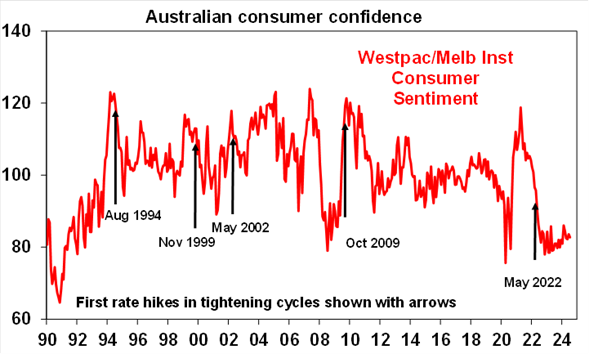
Australian economic data was on the soft side. Consumer confidence fell slightly in July. Falling inflation may have helped drive a slight uptrend in confidence from its lows, but it remains around recessionary levels with talk of higher interest rates and fears of higher unemployment offsetting the boost from the tax cuts.
Source: Westpac/Melbourne Institute, AMP
Easing inflation pressures, central banks moving to cut rates and prospects for stronger growth in 2025-26 should make for reasonable investment returns over 2024-25. However, with a high risk of recession, possible delays to rate cuts and significant geopolitical risks, the next 12 months are likely to be more constrained and rougher compared to 2023-24.
Bonds are likely to provide returns around running yield or a bit more, as inflation slows, and central banks cut rates.
Unlisted commercial property returns are likely to remain negative due to the lagged impact of high bond yields and working from home.
Australian home prices are likely to see more constrained gains over the next 12 months as the supply shortfall remains, but still high interest rates constrain demand and unemployment rises. The delay in rate cuts and talk of rate hikes risks renewed falls in property prices as it’s likely to cause buyers to hold back and distressed listings to rise.
Cash and bank deposits are expected to provide returns of over 4%, reflecting the back-up in interest rates.
Important note: While every care has been taken in the preparation of this document, Farrow Hughes Mulcahy make no representations or warranties as to the accuracy or completeness of any statement in it including, without limitation, any forecasts. Past performance is not a reliable indicator of future performance. This document has been prepared for the purpose of providing general information, without taking account of any particular investor’s objectives, financial situation or needs. An investor should, before making any investment decisions, consider the appropriateness of the information in this document, and seek professional advice, having regard to the investor’s objectives, financial situation and needs. This document is solely for the use of the party to whom it is provided.
Sources: AMP Capital, Pendal, AZ Sestante
