













Global equity markets rose 2.7 per cent in July, taking the year-to-date return to 17.4 per cent in AUD terms. The Australian equity market outperformed global equities in July, rising 4.2 per cent to take the year-to-date gain to 8.6 per cent.
Following a strong July, a correction in equity markets is underway giving back all of last month’s returns in the first week of August. Shares went sky-high into July on the back of better news on inflation, increasing optimism about lower interest rates ahead and optimism about IT and AI related earnings. As July progressed the US mega-cap and AI-related stocks started to falter, partly on comments from Trump in relation to Taiwan but also on the back of earnings results disappointing lofty market expectations. A rotation into small-cap stocks, which had become cheap in relative terms given their exposure to higher borrowing costs and less certain earnings, began as markets started to price in a decline in interest rates
Our view remains that lower interest rates will boost shares on a 12-month view. However, in the next few months global and Australian shares look vulnerable to further falls suggesting that it's too early to buy the dip as: valuations are stretched; investment sentiment looks too optimistic; recession risk is now very high in the US and Australia; and geopolitical risk is high particularly around the US election but also around the Middle East with increasing risks of escalation in the Israel war to include Hezbollah and Iran with risks to oil supplies. So, as we enter the seasonally weak period of August and September a further correction in share prices looks likely.
Fed on track for a September cut but it could be 0.5%. The Fed left rates on hold as expected at its July meeting waiting for more confidence that inflation is falling sustainably back to its target. However, its focus has shifted from mainly inflation to both inflation and employment and Powell indicated a rate cut could be on the table in September. July data showing a sharp slowing in US jobs growth, a further rise in unemployment to 4.3% triggering the so-called Sahm rule and indicating a now very high risk of recession and forward-looking jobs indicators pointing to softer jobs, higher unemployment and slower wages growth ahead all warn that the Fed is falling behind the curve. A 0.5% rate cut is now possible in September and the money market is pricing in nearly five 0.25% rate cuts by year end.
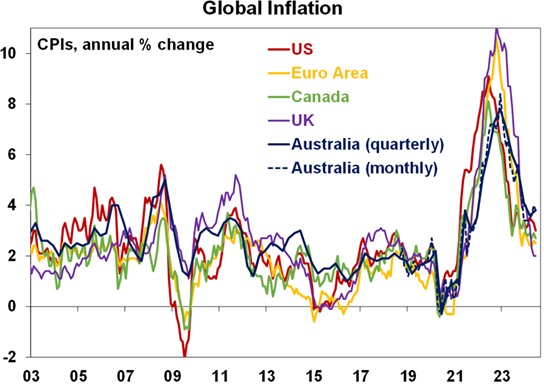
Australian inflation softer than feared. Three months of increases in a row in the ABS’ Monthly CPI Indicator had led many to fear a sharply higher June quarter inflation rate that would trigger more rate hikes. In the event, the Monthly CPI Indicator (yet again) gave a bad steer and June quarter inflation rose but only in line with RBA expectations and not enough to justify another rate hike. In fact, while much is made of Australian inflation being higher than in other countries this just appears to reflect the fact that it lagged other countries on the way up and so is just lagging on the way down. None of this suggests that the economy is slowing sufficiently to allow inflation to fall to levels where rates can be cut. That said, lower global inflation and slowing growth will give the RBA time.
75% of US S&P 500 companies have now reported June quarter earnings. The results are good but proving more mixed and weaker than hoped for from tech stocks. 79.2% have beat earnings expectations which is above the norm of 76% but below the experience of the last reporting season. Consensus expectations for earnings growth are now 9.7%yoy, up from 7.8% at the start of the reporting season.
Easing inflation pressures, central banks moving to cut rates and prospects for stronger growth in 2025-26 should make for reasonable investment returns over 2024-25. However, with a high risk of recession, poor valuations and significant geopolitical risks particularly around the US election, the next 12 months are likely to be more constrained and rougher compared to 2023-24 and there is a high risk of a further correction in the next few months.
Important note: While every care has been taken in the preparation of this document, Farrow Hughes Mulcahy make no representations or warranties as to the accuracy or completeness of any statement in it including, without limitation, any forecasts. Past performance is not a reliable indicator of future performance. This document has been prepared for the purpose of providing general information, without taking account of any particular investor’s objectives, financial situation or needs. An investor should, before making any investment decisions, consider the appropriateness of the information in this document, and seek professional advice, having regard to the investor’s objectives, financial situation and needs. This document is solely for the use of the party to whom it is provided.
Sources: AMP Capital, Pendal , Zenith.
